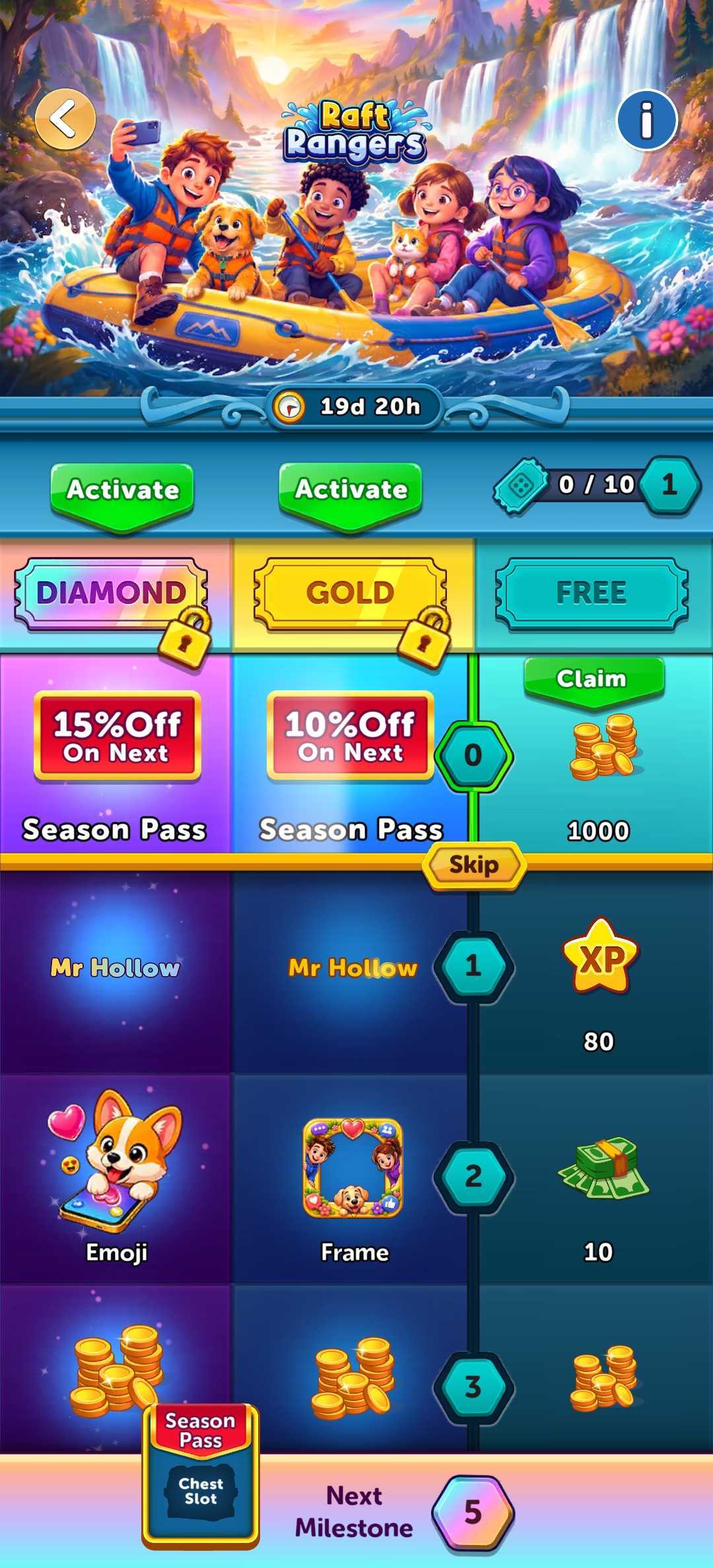
Ludo Club resets to zero after every match. I designed a season pass to give it some momentum, got the first version wrong under a tight deadline, and rebuilt it into something the business could count on.
The first season pass I built for Ludo Club was wrong, and I could see it within a couple of weeks of launch. The useful part is why it was wrong, and what fixing it taught me about designing for a game that never really ends.
Ludo Club has about eleven million people playing every month, and the game has a quiet problem. Every match starts and ends in the same place. You play, you win or lose, and the next game begins from scratch. For a new player that is fine, even nice. But if you have been playing for two years, a game where nothing carries over starts to feel like running in place. We could see it in the numbers. Revenue and engagement were slipping by one or two percent a month, slow but steady.
A season pass is a way to fix that by adding a layer on top. Every match starts counting toward something with an ending. The point was never the rewards. It was to give a flat game a reason to keep going.
I was the only designer on it, and the numbers were sliding fast enough that waiting for a perfect version was not the smart move. So I shipped a small first version to test the idea. That part was the right call. The version itself was not.
Two things, and one of them I only understood once real players had it in their hands.
The rewards were the easy mistake to spot. Coins, premium cash, a few cosmetic items, all of it stuff players could already buy in the store. With more time I would have dug into what people wanted up front. Under the deadline, I shipped the rewards that were quickest to build and planned to learn from there.
The pacing was the subtler one. I tied progress to how many pieces you captured and how many times you rolled the dice, with no daily cap. On paper it was fair. Play more, get further. To size the pacing I leaned on the average player, and the average looked healthy. What I underweighted was how differently the top of the curve moves. My most engaged players, the ones who matter most for a pass, cleared every stage in three days and then had three and a half weeks with nothing left to play for.
It is the kind of thing that looks obvious in hindsight and is easy to miss when you are sizing a system you have not shipped yet, against a clock. The first version did exactly what a first version is for. It showed me the gap I could not see from the outside.
A pass your best players finish in three days is not forward motion. It is the same flat game with a progress bar on top.
The first version had leaned on a quick focus group, which under the deadline was about all there was time for. Focus groups also have a habit of telling you what sounds sensible rather than what people really do. So this time I went deeper. I interviewed real players and grouped what they told me with affinity mapping until the patterns were clear.
Two things came out of it. The first was a relief. Nobody wanted more coins. What they wanted was a reason to keep coming back, something that built up over time. So the idea behind the pass was right. I had just filled it with the wrong things.
The second was the list of right things, and players were specific. An extra power move in a match. Boosters that earn XP and coins faster. New ways to play. A golden name plate. Dice skins and profile frames. They wanted the pass to touch the parts of the game they cared about, not just top up their wallet.
That list had a catch. An extra power move in a match is an advantage you can pay for, and the moment you start selling advantages, a competitive game slowly dies. So I held a line. Anything to do with progress, content or how you look could go in the pass. Anything that helps you win a match could not.
The rebuild came down to two things. Make the pass last the whole month, and fill it with what people wanted.
Pacing was the harder one. I added a daily cap and stopped tying progress to raw captures and dice rolls, which were too easy to farm. Instead, three new stages opened every day, so by the end of the month you could reach the end, but not before. A casual player had all month to get there. A heavy player needed three or four days of real play, somewhere around ten to twelve hours. Either way, the pass no longer ran out on day three.
If someone fell behind and still wanted to finish, they could spend premium currency to jump ahead. That is a way to make money and I am not going to dress it up as anything else. What matters is what you are buying. You can pay to save time. You cannot pay to win a game. Hold that line and the money you make does not come at the cost of the game itself.
The monthly reset does a lot of quiet work. Every month the pass gets a new look, new dice, new frames, a new theme wrapped around the exact same board people have played for years. For a game this old, that small fresh start every month does more for engagement than any single reward inside it.
The hardest part was the one nobody sees. The pass was now feeding XP and coin boosters into an economy that was already carefully balanced. Every booster it gave out changed how much boosters were worth in the store and how fast people climbed. The match itself never changed, but everything feeding into it had to be balanced again around the pass. It looked simple from the outside and was anything but underneath. That is where most of my hardest hours went, and none of it is anything you could put in a screenshot.
It took fourteen versions to get to one I was happy with. That might sound like fourteen failures. It is not. A live game is never finished, you keep adjusting it month after month based on how people behave once it is in the wild. Out of the fourteen, only two really mattered, the one that fixed the pacing and the one that fixed the rewards. The rest were small tweaks.
The thing I am most proud of is not a number on a slide. It is that the pass became predictable. In the early days we watched it closely every month, unsure how it would land. By the end, we could forecast the revenue and engagement it would bring in with reasonable confidence. It went from a gamble to something the business could plan around.
For a game that was quietly losing one or two percent a month, a steady, predictable gain is worth more than a big launch that spikes and then fades. Predictable and a little boring turned out to be exactly what we needed.
The easy version of this story blames the deadline. The deadline was real, but it is not the lesson.
What I changed is narrower and more useful. When you are designing a system you have not shipped yet, the average case will look fine and quietly mislead you. The signal that matters sits at the edges, in how your heaviest and your lightest players move through it. That is the cut I look at first now, especially when time is short, because it is also one of the cheapest things to check.
Shipping a small first version was the right instinct. It told me in a couple of weeks what no amount of planning on paper would have. I would make that call again. What I do differently now is simple. Before anything ships, I decide which single number would prove me wrong. Then I go and look at it.